

Hamas Releases First Israeli Captives Under Ceasefire Deal
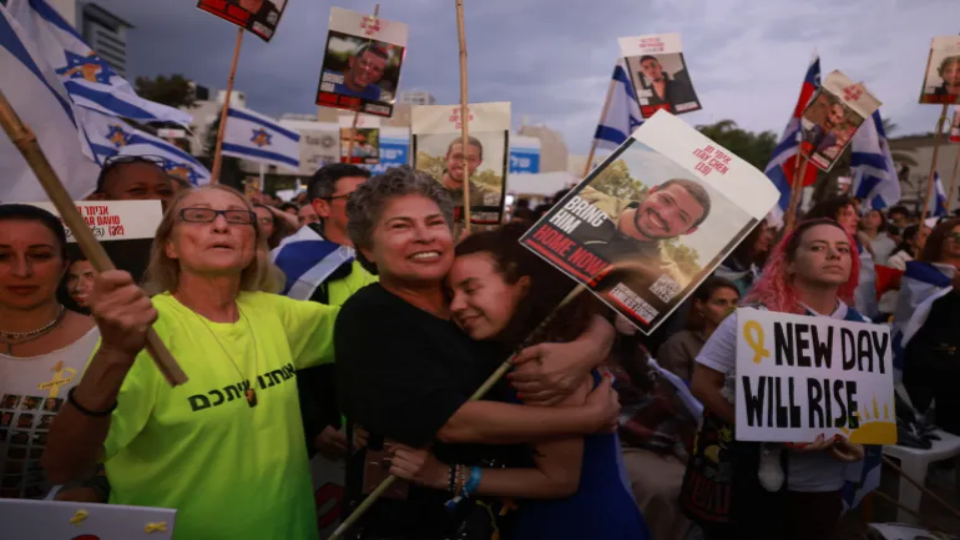
Hamas has released seven Israeli captives to the International Committee of the Red Cross (ICRC) as part of the initial phase of a ceasefire agreement aimed at ending the war in Gaza. The handover, a significant step in the peace process, was met with widespread celebration in Israel, where tens of thousands gathered to watch public screenings of the event on Monday. Israeli television channels broadcast the news that the captives were safely in ICRC custody, prompting cheers across the country.
The Israeli military confirmed the release, stating that the seven captives, identified as Matan Angrest, Gali Berman, Ziv Berman, Alon Ohel, Eitan Mor, Omri Miran, and Guy Gilboa Dalal, were accompanied by the army and Shin Bet intelligence services back to Israel. Upon arrival, the captives were set to undergo initial medical assessments before being reunited with their families and transferred to hospitals for further treatment. Reports from Amman, Jordan, indicated that the released captives were in reasonable condition, able to walk without requiring immediate medical assistance.
The ceasefire deal stipulates that Hamas will release 20 living Israeli captives in exchange for nearly 2,000 Palestinian prisoners held by Israel, many of whom are detained without charge. On Monday, buses carrying the Palestinian prisoners due for release were reported to have left Israeli prisons. In Gaza, a designated medical point was established at Nasser Hospital in Khan Younis to provide health checks for the returning Palestinian prisoners before they reunite with their families. Thousands of Palestinians gathered outside the hospital, eagerly awaiting the released detainees.
The exchange process is structured to ensure all 20 Israeli captives are returned. The remaining 13 living captives were scheduled for release at 07:00 GMT in central Gaza. Hamas had moved the captives to three locations within the enclave to facilitate their transfer to the ICRC. Once Israel confirms that all captives are safely within its borders, it will begin releasing the Palestinian prisoners, including 250 serving life sentences. However, Palestinian leader Marwan Barghouti, whose release has been a long-standing demand, will not be among those freed. Israel has instructed families of released prisoners in the occupied West Bank to refrain from public celebrations or media interactions.
In addition to the living captives, Israel is preparing to receive the bodies of 28 captives confirmed to have died in captivity.
In a televised address on Sunday, Israeli Prime Minister Benjamin Netanyahu described the captives' release as a moment of national unity, quoting a biblical verse and calling it the start of a new path for rebuilding and healing. Despite his optimistic remarks, Netanyahu has faced criticism from some captives' families, who accuse him of prioritizing military objectives over securing their loved ones' release. At a rally in Tel Aviv on Saturday, many in the crowd booed when the U.S. envoy to the Middle East praised Netanyahu's leadership.
The ceasefire deal, approved by the Israeli government three days earlier, was spearheaded by U.S. President Donald Trump, who arrived in Israel on Sunday from Joint Base Andrews near Washington, DC. Accompanied by Secretary of State Marco Rubio, Secretary of War Pete Hegseth, and CIA chief John Ratcliffe, Trump described the captives' release as a special moment, noting that it might occur slightly ahead of schedule. He also acknowledged Qatar's role in mediating the ceasefire and declared the war in Gaza over. Trump’s visit includes meetings with captives' families, an address to the Knesset, and a subsequent trip to Egypt for a summit in Sharm el-Sheikh.
As part of the ceasefire, Israeli forces have withdrawn from parts of Gaza, including Gaza City and northern areas, though they still control over half of the territory. Palestinians returning to these areas have encountered widespread destruction, with neighborhoods reduced to wastelands. Humanitarian aid began entering Gaza on Sunday, with dozens of trucks delivering supplies. However, distribution remains slow, and the population, which has faced severe deprivation for months, urgently needs food, tents, mobile shelters, solar panels, medical equipment, and medicines. Most residents have lost their savings, lack access to bank accounts, and rely entirely on aid to survive.
The Gaza summit, set for Monday in Sharm el-Sheikh, will be co-chaired by Trump and Egyptian President Abdel Fattah el-Sisi. Over a dozen world leaders, including U.N. Secretary-General Antonio Guterres, Jordan’s King Abdullah II, and Turkish President Recep Tayyip Erdogan, are expected to attend. Iran’s Foreign Minister Abbas Araghchi declined to participate, citing U.S. strikes on Iran’s nuclear facilities earlier this year. Although Israel and Hamas will not attend, Egypt has described the summit as a historic event aimed at ending the Gaza war and promoting peace and stability in the Middle East. A document formalizing the end of the conflict is expected to be signed during the summit.
While the first phase of the ceasefire marks significant progress, the second phase remains under negotiation. Key issues include the structure of a post-war administration for Gaza, Hamas’s disarmament, new security and governance arrangements, and reconstruction efforts. The scale of devastation in Gaza, likened to the aftermath of an earthquake, poses significant challenges, with no functioning government, schools, or basic infrastructure in many areas.
U.S. Vice President JD Vance acknowledged the difficulty of achieving lasting stability, emphasizing the need for consistent pressure from U.S. leadership. He clarified that the 200 U.S. soldiers reportedly sent to Israel to monitor the ceasefire will not have a combat role or deploy to Palestinian territory.
The release of the captives and the ceasefire agreement represent a critical step toward peace, but the road to recovery and stability in Gaza remains long and complex.