

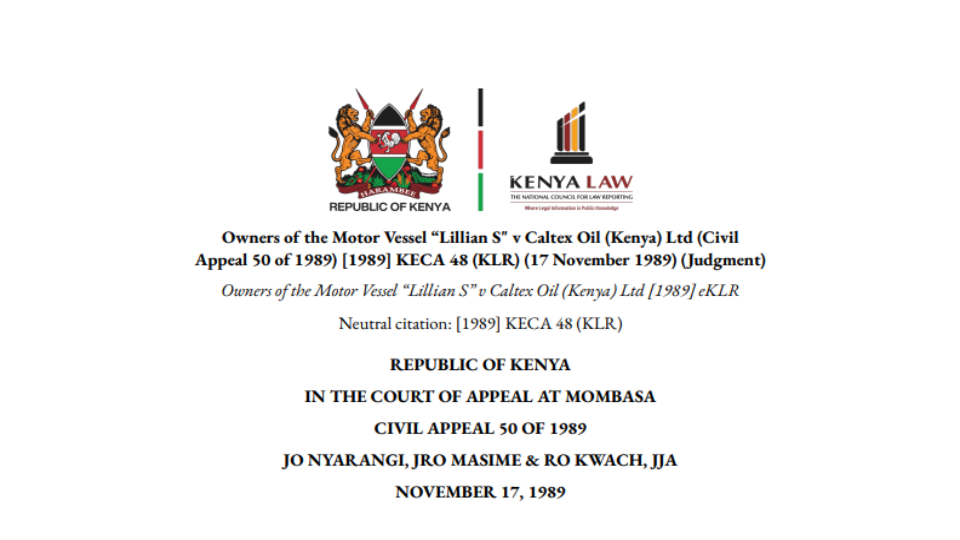
Owners of the Motor Vessel “Lillian S” v Caltex Oil (Kenya) Ltd [1989] KECA 48
Owners of the Motor Vessel “Lillian S” v Caltex Oil (Kenya) Ltd [1989] KECA 48 is one of the most influential decisions in Kenyan jurisprudence and remains the definitive authority on the doctrine of jurisdiction. Decided by the Court of Appeal, the case established the fundamental principle that a court’s power to hear and determine a dispute is derived strictly from law, and that jurisdiction must be ascertained at the very outset of proceedings. The decision has since become the starting point for jurisdictional analysis across all areas of Kenyan law, including commercial litigation, land disputes, constitutional petitions, and judicial review.
The dispute arose from an admiralty claim involving the motor vessel “Lillian S.” Caltex Oil (Kenya) Ltd instituted proceedings in the High Court seeking relief connected to the vessel. The owners of the vessel challenged the proceedings through a preliminary objection, arguing that the High Court lacked admiralty jurisdiction under Kenyan law as it then existed. As a result, the case did not turn on the merits of the commercial dispute, but rather on the more fundamental question of whether the court itself was legally competent to entertain the claim. This shift in focus compelled the Court of Appeal to address the nature, source, and consequences of jurisdiction in Kenyan law.
The central issue before the Court of Appeal was whether the High Court had jurisdiction to hear the matter and, if it did not, whether it could nonetheless proceed with the case or defer the jurisdictional question to a later stage. In resolving this issue, the Court articulated a clear and uncompromising position: jurisdiction is the foundation of judicial authority. A court derives its power solely from the Constitution or statute, and where that power is absent, the court has no mandate to act. Jurisdiction is therefore not a procedural technicality but a substantive legal requirement that goes to the root of judicial power.
In its reasoning, the Court emphasized that jurisdiction must be determined at the earliest possible opportunity. Justice Nyarangi JA delivered the now-famous dictum that “jurisdiction is everything” and that without it, a court has no power to take even one further step. Once it becomes apparent that jurisdiction is lacking, the court must immediately “down its tools.” This principle imposes a mandatory duty on courts to halt proceedings the moment a jurisdictional defect is identified, without considering evidence, submissions, or the merits of the dispute.
The Court further held that proceedings conducted without jurisdiction are void ab initio. Such proceedings are not merely irregular or defective; they are legally nonexistent. No amount of judicial effort, party consent, or procedural compliance can cure a jurisdictional defect once established. This aspect of the decision explains why jurisdictional objections are often fatal and why courts treat them with priority over all other issues.
A particularly important holding in Lillian S is that jurisdiction cannot be conferred by consent, acquiescence, waiver, or convenience. Even where all parties wish the court to proceed, the court remains bound by the limits imposed by law. Jurisdiction is an objective question of legal authority, not a matter of agreement between litigants. This principle continues to have significant implications in cases involving forum selection clauses, alternative dispute resolution mechanisms, and statutory tribunals.
The decision also highlighted the close relationship between procedural compliance and jurisdiction. Where legislation prescribes specific procedures or conditions for invoking a court’s jurisdiction, those requirements are mandatory. Failure to comply may prevent jurisdiction from attaching altogether. This reasoning later informed doctrines such as exhaustion of statutory remedies, compliance with mandatory notices, and adherence to statutory timelines, reinforcing the idea that procedure can operate as a gateway to jurisdiction.
Applying these principles to the facts before it, the Court of Appeal concluded that the High Court lacked jurisdiction to hear the admiralty claim as instituted. The proceedings were accordingly struck out without any consideration of the merits. The Court’s refusal to engage with the substantive dispute underscored its position that, once jurisdiction is absent, there is no lawful basis upon which to proceed further.
The jurisprudential significance of Lillian S cannot be overstated. It complements the principles set out in Mukisa Biscuit Manufacturing Co. v West End Distributors by illustrating jurisdiction as the clearest example of a proper preliminary objection. It has also been repeatedly affirmed by later courts, including the Supreme Court, most notably in Samuel Kamau Macharia v Kenya Commercial Bank, where the Court reiterated that jurisdiction flows from the Constitution or statute and cannot be expanded by judicial interpretation. This confirms that Lillian S remains authoritative even under the 2010 Constitution.
Practically, the case imposes a clear discipline on advocates, courts, and litigants alike. Advocates must rigorously interrogate jurisdiction before filing or defending any matter, including subject-matter competence, territorial limits, monetary thresholds, and statutory procedures. Courts bear a continuing duty to satisfy themselves of jurisdiction, even where parties do not raise the issue. For litigants and businesses, the case serves as a cautionary reminder that a strong claim pursued before the wrong forum may fail without ever being heard on its merits.
Ultimately, Owners of the Motor Vessel “Lillian S” v Caltex Oil (Kenya) Ltd endures because it affirms a simple but uncompromising truth: judicial power flows from law, not convenience, consent, or sympathy. By insisting that jurisdiction comes first, the case reinforces legal certainty, institutional legitimacy, and the rule of law at the heart of Kenya’s legal system.
Read the Full Case here - Owners of the Motor Vessel “Lillian S” v Caltex Oil (Kenya) Ltd [1989] KECA 48