

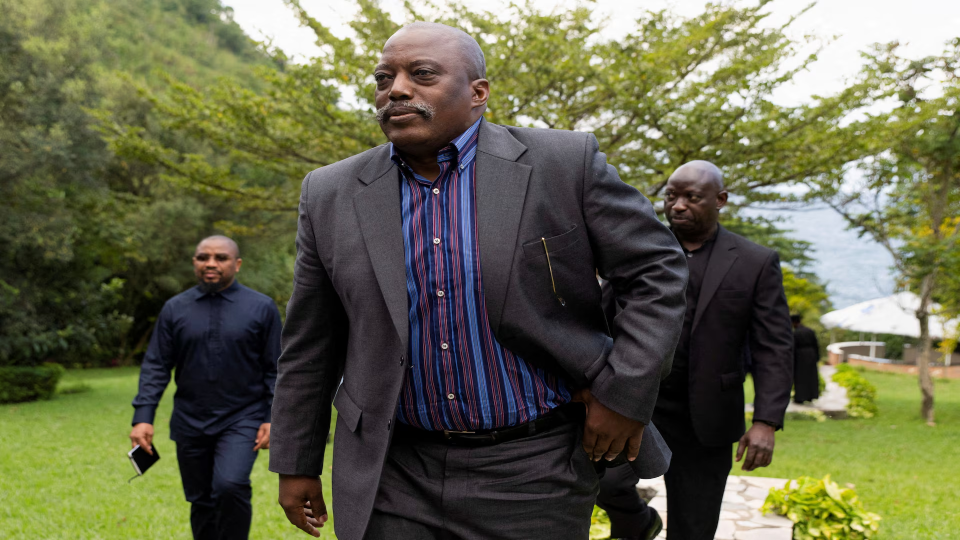
Kabila Launches New Alliance with M23 Rebels, Deepening Crisis in DR Congo Peace Efforts
Former Democratic Republic of Congo President Joseph Kabila has launched a new political and military coalition that includes the M23 rebel group, marking a significant escalation in the opposition to President Félix Tshisekedi’s government and adding fresh obstacles to ongoing peace negotiations in the country.
On Monday, Kabila formally unveiled the Front for the Refoundation of the Nation, known as FRN, during a ceremony in Goma, the eastern city that has been under rebel control. The coalition brings together various groups previously aligned under the Congo River Alliance. Corneille Nangaa, the former leader of that alliance, has been named as one of the FRN’s four vice presidents.
Speaking at a news conference held late Monday at Kabila’s residence in Goma, coalition adviser Claude Ibalanky outlined the group’s objectives. He stated that the FRN aims to restore the foundational pillars of a functioning republic. The coalition seeks to unite and coordinate all resistance forces in order to end what it describes as tyranny, using any means necessary, including force. The signatories have agreed to combine their forces, resources, and capabilities to establish a framework through which Congolese citizens can work together to liberate their country.
The Tshisekedi administration has not issued an immediate response to the announcement.
The formation of the FRN presents a direct and multifaceted challenge to the government in Kinshasa. By merging political opposition with armed rebel movements, Kabila has assembled a force capable of confronting the authorities on both political and military fronts. The participation of M23 carries particular weight. That group seized Goma, the capital of North Kivu province, along with several other important urban centers during a rapid offensive last year. This battlefield success lends the new coalition tangible military standing.
M23 ranks among roughly 100 armed factions competing for influence in the mineral-rich eastern regions of Congo, near the border with Rwanda. The area has endured decades of conflict that have produced one of the most severe humanitarian crises worldwide. Congolese authorities, the United States, and United Nations experts have repeatedly accused Rwanda of providing support to M23. Rwanda has consistently rejected those claims.
Kabila governed Congo from 2001 until 2019. He assumed the presidency at the age of 29 following the assassination of his father, Laurent Kabila. Toward the end of his tenure, he postponed elections by two years beyond the constitutional deadline. In the December 2018 vote, the candidate he backed was defeated by Tshisekedi, a longtime political rival who has held power since 2019.
Last year, a high military court in Congo sentenced Kabila to death in absentia. The court convicted him of treason, war crimes, and crimes against humanity, asserting that he had collaborated with Rwanda and M23. Kabila rejected the charges and described the trial as politically driven. Earlier this year, the United States imposed sanctions on him over allegations that he funded and offered political backing to rebel groups active in eastern Congo.
The emergence of the FRN poses a serious setback for the already fragile peace process. Multiple diplomatic initiatives, including African Union-led mediation, efforts by the East African Community and the Southern African Development Community, the Washington process, and the Doha dialogue, have yielded only limited progress. The African Union Panel of Facilitators has been traveling between Goma, Kigali, and Kinshasa in an attempt to narrow differences among the parties. Kabila’s coalition now confronts Kinshasa with a coordinated political and military opposition that risks undermining those mediation efforts.
The development also invites scrutiny of Kabila’s longer-term intentions. After seven years outside office, his decision to reenter active politics in partnership with rebels whom Kinshasa regards as Rwandan proxies indicates a determination to pursue a return to influence. Whether he can successfully bring Congo’s divided opposition under a single banner remains uncertain.