

Appeals Court Rules Trump Administration Can Deploy National Guard to Portland Amid Ongoing Legal Battles
A federal appeals court has overturned a lower court decision that blocked the Trump administration from deploying National Guard troops to Portland, Oregon. This ruling represents a significant legal win for the administration in its efforts to address protests in the city. The decision came from the Ninth Circuit Court of Appeals on Monday, lifting one of two temporary restraining orders issued by a district judge last week. However, the second order remains in place, preventing the immediate deployment of troops. In response, the administration filed a motion later that evening to have the remaining order vacated or stayed, arguing that both orders relied on the same legal grounds.
The panel of three judges included two appointed by President Trump, who voted in favor of the administration, and one appointed by former President Bill Clinton, who dissented. The majority opinion noted that while the president may have overstated the intensity of the protests on social media, other evidence provided sufficient justification to meet the legal standards for deployment. The dissenting judge criticized the ruling as undermining core constitutional principles, including state authority over militias and protections for free assembly and protest.
The White House welcomed the decision, stating it confirms the president's legal right to protect federal properties and staff in the face of unrest that local officials have not adequately managed. The deployment is intended to secure the Immigration and Customs Enforcement facility in Portland, where protests have occurred.
Oregon's attorney general condemned the ruling, expressing concern that it could allow the president broad power to station troops in the state with minimal cause, potentially setting a risky precedent for the nation. He called for a full court review by a larger panel and urged quick action. Later that day, a judge on the circuit initiated a vote for such a review, which is possible though typically requested by the parties involved. The state intends to submit its own request for reconsideration, with deadlines set for Wednesday midnight.
Oregon's governor voiced strong worry about the ruling during a virtual press briefing, highlighting the strain on National Guard members who are currently on standby, separated from their homes and work. She supported the dissent and noted the significance of the immediate call for review. If the second order is lifted, details on troop numbers and locations remain unclear due to limited communication from the administration. State leaders have challenged the president's description of Portland as a severely disrupted area, asserting that conditions are not as dire as portrayed.
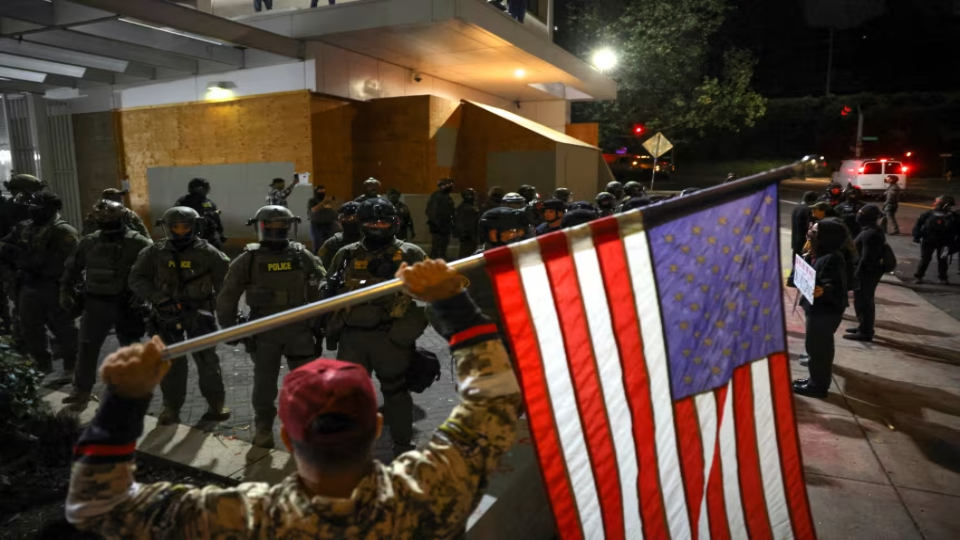
Protests in Portland started in June in response to federal immigration policies. By midsummer, incidents included a declared riot and arrests for arson near the immigration facility. The situation quieted until late September, when the president announced plans to send 200 National Guard troops. Clashes between federal agents and protesters occurred at the facility on October 12, and earlier images showed individuals with flags amid security presence on October 3.
This development follows the administration's recent urgent appeal to the Supreme Court regarding troop deployment in Chicago, where a similar lower court block was challenged as interfering with presidential powers and risking federal safety.
Last Friday, several senators, including those from Oregon, requested an investigation by the Defense Department's inspector general into recent National Guard activations across the country. They described these actions as unconstitutional and harmful to civil liberties, potentially overburdening military capabilities and personnel, especially against local opposition.
The Portland decision coincides with the president's recent statements about sending troops to San Francisco as part of efforts to address issues in certain cities. In a television interview on Sunday, he described San Francisco as having declined due to policy shifts and pledged to intervene to restore it. He characterized targeted locations as predominantly managed by Democrats, unsafe, and in disarray, mentioning the potential use of a rarely invoked law that permits military involvement in domestic situations under specific conditions.
Such deployments to cities including Chicago, Memphis, and Portland have drawn strong opposition from locals, officials, and led to legal challenges. They have also inspired additional protests, including large-scale rallies over the weekend with widespread participation across thousands of events nationwide opposing the administration's approach.
The president recently indicated interest in deploying troops to the Bay Area, identifying San Francisco as a city in need of correction. A California state senator representing the area rejected the idea, stating the city does not require or desire federal military presence and warning against authoritarian measures. The state's governor similarly opposed any involvement, asserting it would harm a major American city.
A prominent Bay Area business leader initially expressed support for added security ahead of a major conference but later withdrew that stance, clarifying that military assistance is unnecessary and regretting any alarm caused.
San Francisco's mayor has not specifically responded to the president's remarks but noted in a recent briefing that crime rates have dropped significantly to historic lows. The city is addressing police staffing shortages with a notable increase in recruit applications this year.
The California governor previously filed a lawsuit against the administration over the federal takeover of the state's National Guard for protests in Los Angeles and joined Oregon's legal action against sending those troops to Portland.
Seven officials in Tennessee initiated legal action last week against their state's governor and attorney general over the deployment of National Guard troops to Memphis directed by the president. They argued that this violates state laws, which allow activation only in cases of rebellion or invasion deemed necessary by the legislature, circumstances not applicable here.
Federal troops began appearing in Memphis on October 10, including patrols alongside local police at key sites. The city's mayor defended Memphis by pointing to substantial crime reductions but acknowledged the unique decision-making process involving the state governor and president. The police chief expressed hope that troops would handle non-enforcement tasks like traffic control and visibility in public areas to prevent a sense of excessive militarization.
National Guard personnel were observed supporting police in entertainment districts on October 16.
Illinois and Chicago officials filed with the Supreme Court on Monday to prevent the administration's emergency bid to keep National Guard troops in place despite local resistance. A district court had issued a block earlier this month, which an appeals court partially upheld, allowing preparation but not actual deployment, with the stay ending soon. The high court now faces a decision on allowing deployment while litigation continues.
The filing contends that no conditions of unrest or inability to enforce laws exist, describing protests at a local immigration facility as minor and handled locally without impacting operations. It raises concerns about unconstitutional pressure on states to align with federal directives or face takeover.
The administration's response highlights risks to federal staff and assets, depicting incidents in Chicago as severe, including coordinated attacks on officials. Recent court sessions addressed clashes, with a judge requiring explanations on force usage and protections for media, expanding orders to mandate body cameras for certain agents, though with exceptions.
Protesters gathered in a major park for rallies against the administration over the weekend.
These disputes highlight tensions between federal and state powers, with broader effects on executive authority, individual rights, and the role of the military in domestic affairs across various locations.